 My Fisio Agenda
Plenty of physiotherapists decide to open a physiotherapy clinic in Spain after a few years working for someone else or doing home visits. The clinical side is the part you already know. What usually holds people back is everything else: which permits you need, in what order to apply, who inspects the premises and what paperwork you will need from the very first patient.
This guide puts all of that in order. It goes through the physiotherapy clinic requirements in Spain: the health authorisation from your autonomous community, the town hall licence, tax and social security registration, data protection and what to check about the premises before you sign. Each region runs its own procedure, so here you will find the part that is the same across the country and the questions to ask in yours. We also explain the Spanish terms along the way, since many readers come from abroad.
Before you start: a practice of your own or a clinic with a team
The first decision shapes almost every other one. A physiotherapy practice where you treat patients yourself, with one treatment table and perhaps someone on reception, has little in common with a centre with three or four physiotherapists, several rooms and a space for therapeutic exercise.
Royal Decree 1277/2003, which sets the national rules for authorising healthcare centres, calls a centre where a health professional other than a doctor or a dentist carries out healthcare a «practice of other health professionals». It is still a practice if more people work there, as long as care centres on one professional and the rest support them. If several physiotherapists will treat patients on an equal footing, your region will tell you which type of centre you fall under. Either way, the service you are authorised for is listed as U.59 Physiotherapy.
Think about the legal structure as well. Many physios start as self-employed (autónomo) and set up a limited company (sociedad limitada) once they hire staff or go into business with a colleague. An accountancy firm (gestoría) that knows the healthcare sector can run the numbers for both options in an afternoon.
Requirements for opening a physiotherapy clinic in Spain
Before thinking about premises, check what you need as a professional and as the person running the business. These requirements are the same all over Spain; the forms, fees and waiting times change from one region to another.
Qualification and professional registration
To practise you need a degree (or the older diploma) in Physiotherapy and membership of the professional association of physiotherapists (colegio) in your region. If you qualified outside Spain, you will first need your qualification recognised. The colegio is also a good place to ask about the procedures in your area.
Liability insurance
It is compulsory. Article 46 of Law 44/2003 on the health professions (in Spanish) requires health professionals working in private practice, and companies that provide healthcare, to hold professional liability insurance, a bank guarantee or another financial guarantee covering any harm caused to patients. Many colegios include or arrange a group policy. If you open a centre, check that it covers the business itself and every professional working there, and that it includes the techniques you will use, such as dry needling.

Tax and social security registration
Before you issue your first invoice you need to register with the tax agency using the census declaration (form 036) and with social security, usually under the scheme for the self-employed. If you hire anyone, you also have to register as an employer with social security.
The business activity tax (IAE) has a detail worth knowing. A physiotherapist working on their own account, without a centre behind them, registers under group 836 of section two. When the activity is carried out through a centre, the tax authorities treat it as a business: in binding ruling V0711-20, about a physiotherapist opening a centre who would start out working alone, the Directorate General for Taxation concluded that heading 942.9 of section one applied, «other healthcare services without admission». Discuss it with your gestoría before you register.
As for VAT, healthcare provided by physiotherapists to diagnose, prevent or treat illness is exempt (article 20.1.3 of Law 37/1992). Invoices for sessions are issued without VAT and state the exemption. Selling products follows its own rules.
Data protection from the first patient
You will be handling health data, which the General Data Protection Regulation treats as a special category. That has practical consequences from day one:
- you must keep a record of processing activities (article 30 of the GDPR), because the exemption for organisations with fewer than 250 employees does not apply when health data is processed;
- you have to tell every patient who processes their data, why, and how they can exercise their rights;
- you sign a data processing agreement with every supplier that can access that data (your practice management software, your gestoría, your IT support);
- healthcare centres that are legally required to keep clinical records must appoint a data protection officer, under article 34 of Organic Law 3/2018. The law leaves out professionals who work on an individual basis: if you work alone you do not need one, while a clinic with several professionals, in principle, does.
The Spanish Data Protection Agency has a health section in English that explains the legal basis for processing patient data and how to respond when patients exercise their rights.
Clinical waste
If you do dry needling or any other technique with needles, you will need sharps containers and an authorised waste contractor to collect them. Clinical waste rules are set by each region, so ask yours how this waste is classified and how often it has to be collected.
The health authorisation and the town hall licence
This is usually the step that takes longest. Royal Decree 1277/2003 (in Spanish) gives the autonomous communities the power to authorise the setting up, operation, modification and closure of every healthcare centre. The operating health authorisation has to be obtained before you start treating patients, for each centre and for each service it offers, and every region decides whether it must be renewed and how often.
Some regions also ask for an installation authorisation when the centre is new and building work or major changes are involved. Later on, if you change the layout, the owner or the services offered (because you add an exercise room or move from self-employed to a company, for example), you will need a modification authorisation.
In practice, the regional health department reviews the documents for the premises and the owner, and it normally carries out an inspection before deciding. Once the authorisation is granted, the centre is entered in the register of healthcare centres and has to display the official sign showing it is authorised somewhere visible (article 6 of the same royal decree).
The town hall licence is a separate procedure. Depending on the municipality it will be an activity licence, a prior notification or a declaration of compliance (declaración responsable). The same royal decree says that when another body has to approve the opening of a healthcare centre, it must first check that the centre holds its operating authorisation. That is why it pays to ask both the town hall and the health department which order they want the paperwork in before any building work starts.
The premises: what to check before signing the lease
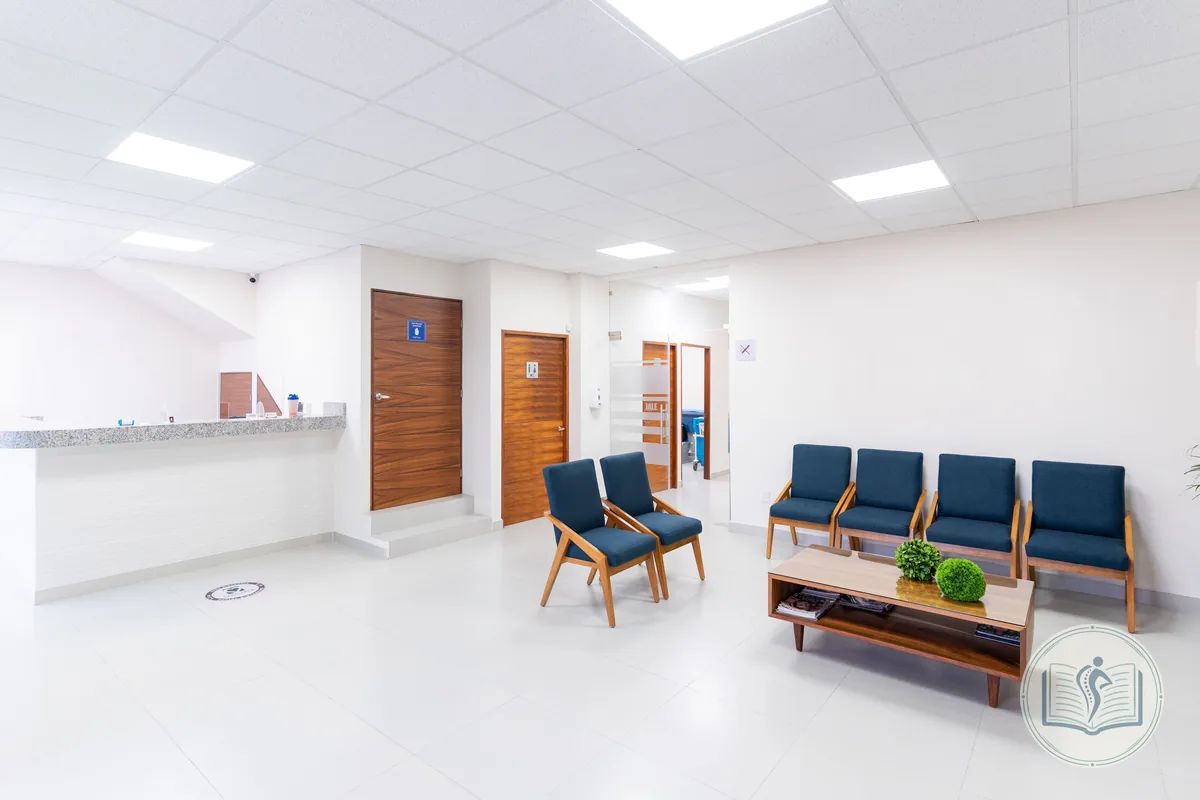
A lot of the problems new clinics run into start with the wrong premises. Before you sign, ask the town hall whether healthcare use is allowed in that building, read the rules of the owners' association (comunidad de propietarios) and ask the regional health department for its technical requirements for centres without inpatient beds. They usually cover the layout of the rooms, accessibility, ventilation and lighting, a washbasin in treatment areas and where materials are stored.
Walk through the premises as a patient would. Can someone on crutches get in without climbing steps? Is there somewhere to sit and wait? Can you hear from the waiting room what is said in the treatment room? A ground-floor unit that used to be a shop may need more work than it looks to divide it into treatment rooms, soundproof them and fit an accessible toilet. When you negotiate the lease, try to have the rent start only once you have the permits, or ask for a few rent-free months.
Equipment and costs of setting up a physio clinic
What it costs to start a physio practice in Spain depends mostly on the building work and the equipment, which is why a general figure tells you very little. The useful thing is to list every item in a spreadsheet and get three quotes for each:
- deposit, rent and refurbishment of the premises, including the technical project if the health department asks for one;
- treatment tables, chairs, exercise equipment and the electrotherapy or other devices you will use from day one;
- fees for the health authorisation and the municipal licence;
- colegio membership, liability insurance and insurance for the premises;
- accountancy, data protection and clinical waste collection;
- practice management software, a website and a sign for the door;
- a cushion for the first few months, while the diary is still filling up.
Equipment can be added over time. Start with what you really use in your treatments and buy the rest once you see what patients ask for.
Day-to-day paperwork: clinical records, consent and invoices
Once the clinic is open, every session comes with obligations, and it helps to have them sorted before the first patient walks in.
The clinical record must be kept for at least five years after each episode of care ends (article 17 of Law 41/2002), and some regions extend the period for part of the documentation: in Catalonia, for example, informed consent forms and discharge reports are kept for fifteen years. Consent is usually given verbally, but it has to be in writing for invasive procedures or those with significant risks (article 8 of the same law), such as dry needling. If you set up informed consent with a digital signature from the start, you skip the printing, scanning and filing.
If you invoice with software, it will have to comply with VeriFactu. Royal Decree 1007/2023 requires every invoice to generate a chained record that cannot be altered, and the dates in force are 1 January 2027 for companies and 1 July 2027 for everyone else, self-employed professionals included. In October 2026 the tax authorities announced that they want to push the dates back to October 2028, but until that appears in the Official State Gazette (BOE) the 2027 dates still apply. A clinic opening now can start straight away with VeriFactu invoicing for physiotherapists and avoid switching tools a few months later.
How to get your first patients
At first most patients come from your own circle and from the professionals you already worked with. To reach everyone else:
- create your clinic's Google Business Profile with the address, opening hours, real photos of the premises and the physiotherapist category, and ask patients to leave a review;
- add a booking link to your website and to that profile, so people can ask for an appointment while you are busy treating;
- introduce the clinic to doctors, orthopaedic surgeons, podiatrists, personal trainers and sports clubs nearby;
- switch on WhatsApp reminders from the first day, because an empty slot hurts more while the diary is only half full.
The order of the steps, from the idea to opening day
The exact timetable depends on your region and on the building work, but this order avoids most of the bottlenecks:
- Join the colegio, if you have not already, and take out liability insurance.
- Decide whether to start as self-employed or as a company, and choose a gestoría.
- Before signing the lease, confirm with the town hall that the premises allow healthcare use and ask the health department for its technical requirements.
- Commission the project, carry out the work and apply for the licence or file the declaration of compliance with the town hall.
- Apply for the operating health authorisation and get ready for the inspection. In some municipalities these last two steps run the other way round, so check first.
- Register with the tax agency and social security before your first invoice.
- Get data protection ready: record of processing activities, patient information and agreements with your suppliers.
- Set up your practice management software, your diary and your consent templates, and open online bookings.
My Fisio Agenda for your new clinic
When opening day is close, the physiotherapy clinic software from My Fisio Agenda takes care of the admin side from the first patient:
- the whole team's diary in real time, with rooms, recurring sessions and blocked hours;
- clinical notes for every session, private and encrypted, with your own fields and patient files;
- informed consent with a digital signature on a phone or tablet, for adults and for minors;
- automatic WhatsApp reminders with buttons to confirm or cancel the appointment;
- a public booking page with its own link that you can put on your website;
- VeriFactu-ready invoicing with the healthcare VAT exemption, invoices from the centre or from each physio, commissions and settlements;
- servers in the European Union, encrypted daily backups and a data processing agreement.
Clinic plans cover up to 5, 10 or 15 physiotherapists and cost from €99.99 to €159.99 a month, with no long-term contract and VAT added on top. If you will be working alone for now, plans for individual professionals start at €4.99 a month. You can try it free for 1 month, no card needed, and have the diary ready while the builders finish.
Frequently asked questions about opening a physiotherapy clinic in Spain
Short answers to the questions we hear most from physiotherapists about to open their own centre.
What do I need to open a physiotherapy clinic in Spain?
A physiotherapy qualification recognised in Spain, membership of the regional colegio, liability insurance, registration with the tax agency and social security, the operating health authorisation from your autonomous community, the town hall licence or declaration of compliance, and data protection in order. Each region also sets its own technical requirements for the premises.
How long does the health authorisation take?
It depends on the region, on whether building work is involved and on when the inspection can take place. Ask the regional health department how long it takes to decide before you sign the lease and, if you can, negotiate that the rent only starts once you have the permits.
Do I have to charge VAT on physiotherapy sessions?
No. Healthcare provided by physiotherapists to diagnose, prevent or treat illness is exempt from VAT under article 20.1.3 of Law 37/1992. The invoice is issued without VAT and states the exemption. Selling products follows its own rules.
Which IAE activity code applies to a physiotherapy clinic?
If you work on your own account without a centre, group 836 of section two. If the activity is carried out through a centre, the Directorate General for Taxation considers it a business, under heading 942.9 of section one (binding ruling V0711-20). Confirm it with your gestoría.
Does a physiotherapy clinic need a data protection officer?
Article 34 of Organic Law 3/2018 requires healthcare centres that must keep clinical records to appoint one, and leaves out professionals who work on an individual basis. If you work alone you do not need one; a clinic with several professionals, in principle, does.
Can I open a physiotherapy practice at home?
It depends on your town hall and your region. The home has to allow healthcare use and meet the same technical requirements as any other centre, and you still need the health authorisation. The rules of the owners' association may also restrict it, so check before you spend money on building work.
What software do I need to run a physiotherapy clinic?
Software that brings together the whole team's diary, clinical records, signed consent forms, reminders and VeriFactu-ready invoicing. My Fisio Agenda has clinic plans for 5, 10 or 15 physiotherapists, in English, Spanish and Catalan, and you can try it free for 1 month without a card.